

Developing and manufacturing tools and prototypes can be an uphill task. In a highly competitive manufacturing environment, the right fabrication method may decide whether a pipeline project will be launched or not. The reasons are multifaceted since traditional manufacturing processes like injection molding, thermoforming or casting can have big challenges to overcome:
- High upfront costs to finance e.g. prototypes, molds, or patterns.
- Long lead times (weeks or months) to get the parts from providers.
- Roadblocks in product development that delay the process and may lead to a competitive disadvantage.
Nowadays, rapid prototyping and tooling with industrial 3D printers provide a contemporary way of manufacturing inhouse that is faster, budget-friendly, and autonomous. Let’s take a critical look at this modern manufacturing method.

What is Rapid Production Tooling?
Rapid production tooling is a technique to manufacture tools and prototypes with the aid of 3D printing technology such as the fused filament fabrication (FFF) method. Compared to rapid prototyping – which focuses on iterating parts – rapid tooling concentrates on manufacturing tools like jigs, fixtures, molds, patterns, or dies. These tools are utilized in traditional processes to fabricate the final parts afterward. Rapid production tooling closes an important gap between prototyping and the final production of end-use parts.
What are the benefits of Using 3D Printing for Production Tooling?
There are several aspects that definitively show the benefits of rapid prototyping and tooling with 3D printing technology:
3D printing is faster
3D printers allow significantly quicker production periods than conventional methods. This is thanks to in-house production, reduced logistics, and fast technology. With rapid tooling services, fabricating parts only takes hours or days, rather than weeks or months. This time saving is valuable for product developers to check out their design, material, and usability – and adjust them if necessary.
3D printing is economical
Due to faster manufacturing, the total development and project costs are being reduced. Especially in comparison with conventional methods like CNC machining, the initial costs for smaller quantities or prototypes are often lower. Also, complex geometries are easier and more favorable to make with rapid tooling.
3D printing has premium quality
Advanced industrial 3D printers enable high-quality results, preciseness, and consistency on a production level. The result is that less to no post-treatment is needed.
3D printing is flexible
Whether engineers want to try out different designs, materials, or sizes during prototype development or manufacturers wish to test the acceptance of a new product in a market to widen their product range: rapid tooling makes it easy to produce modified duplications with a small number of units thanks to the flexibility of 3D printers. This saves valuable money and time.
3D printing is within reach
Industrial 3D printing machines are available in different sizes, so engineers and designers can easily choose the right format that bests fits their needs and available space. Thus, having the 3D printer available in-house makes it easy to work with and get the printed items immediately – rather than waiting for weeks with conventional manufacturing processes and outsourcing.

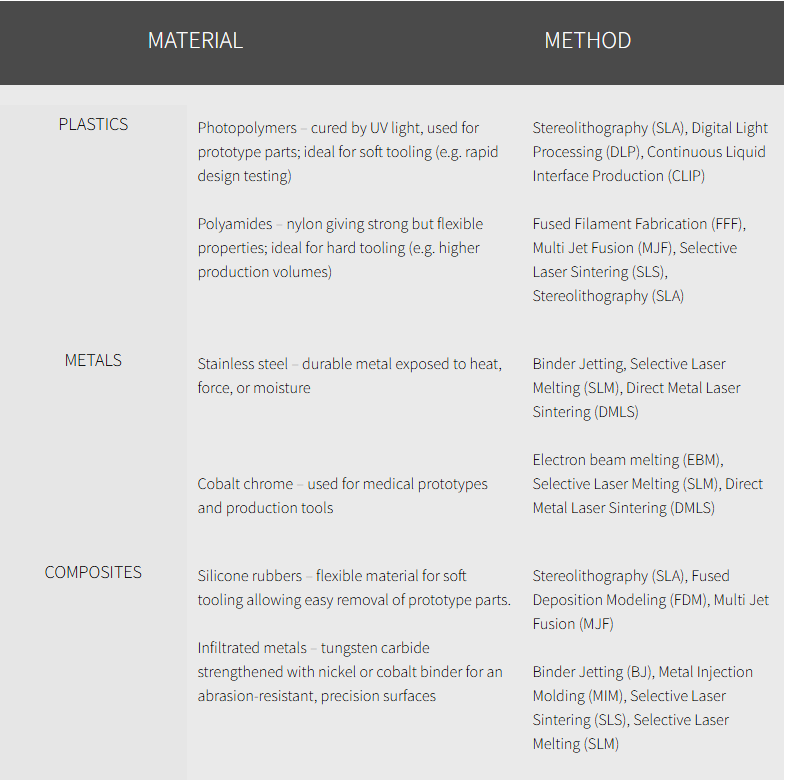
Which 3D Printing Materials and Methods work well for Tooling?
There are numerous materials and methods applicable for rapid tooling with an industrial 3D printer. The table below is just a little extract.
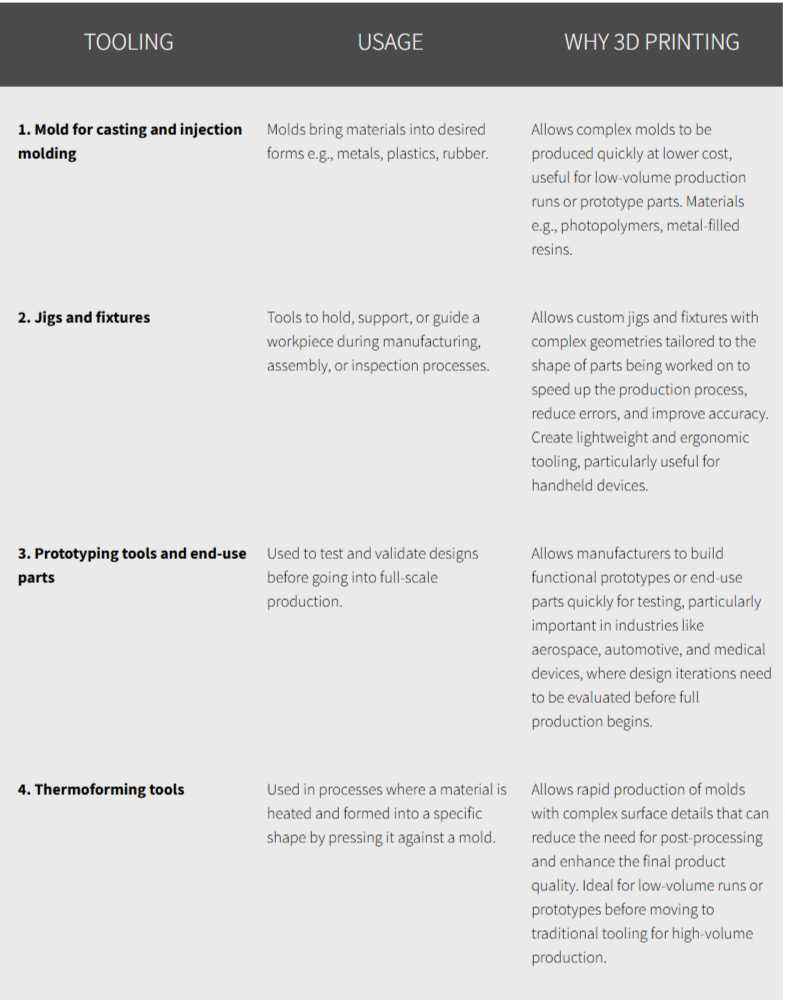
Which Types of Tooling benefit from 3D Printing?
Since the list of types benefitting from 3D printing is extensive, here we only focus on the most common ones.
From Printer to Racetrack – A Practical Example
In the following example, a large mold was printed and used as a lay-up tool for a composite structure to produce the final part. Here’s an overview of the process:


What are the Considerations and Limitations of 3D Printing for Tooling?
Although rapid prototyping and tooling with 3D printers come up with various advantages, users should consider some challenges that go along with this manufacturing method.
Costs
First things first: an industrial 3D printer is a major purchase which implies high initial costs (e.g. printer, material, software, service). It will take some time – and prints – until it amortizes. It will save money in the long term since it’s a flexible, instant in-house solution without further major expenses. Alternatively, rapid tooling services provide access to affordable rapid tooling solutions.
Durability
Items made by additive methods may fail sooner than those made by conventional tooling. The reasons for this vary:
- Material limitations: Some materials (e.g. plastics) have lower mechanical strength and high-temperature resistance than metals.
- Layered structure: Since 3D printed tools are built layer by layer, there are weak interfaces between the layers which could lead to delamination.
- Thermal and mechanical stress: When exposed to temperature fluctuation, additive items with poor thermal conductivity may crack, warp, or weaken.
Considering the lifespan of a tool, rapid tooling can reduce the total costs through fast design cycles and iterations.
Surface
Compared to conventionally manufactured tools, the surface of items produced with 3D printers often needs attention. However, after post-treatment like polishing or dragging, the tools and prototypes receive a plane surface.
A Game Changer in Manufacturing
All in all, rapid tooling and prototyping have changed the way manufacturers plan, produce, and place their pipeline products on the market. With various industrial 3D printers and filaments for different possible applications, BigRep empowers engineers and designers to accomplish their manufacturing goals.

What is your next tooling project? Let’s talk about it and find out how our industrial 3D printing machines can make your ideas become real.


